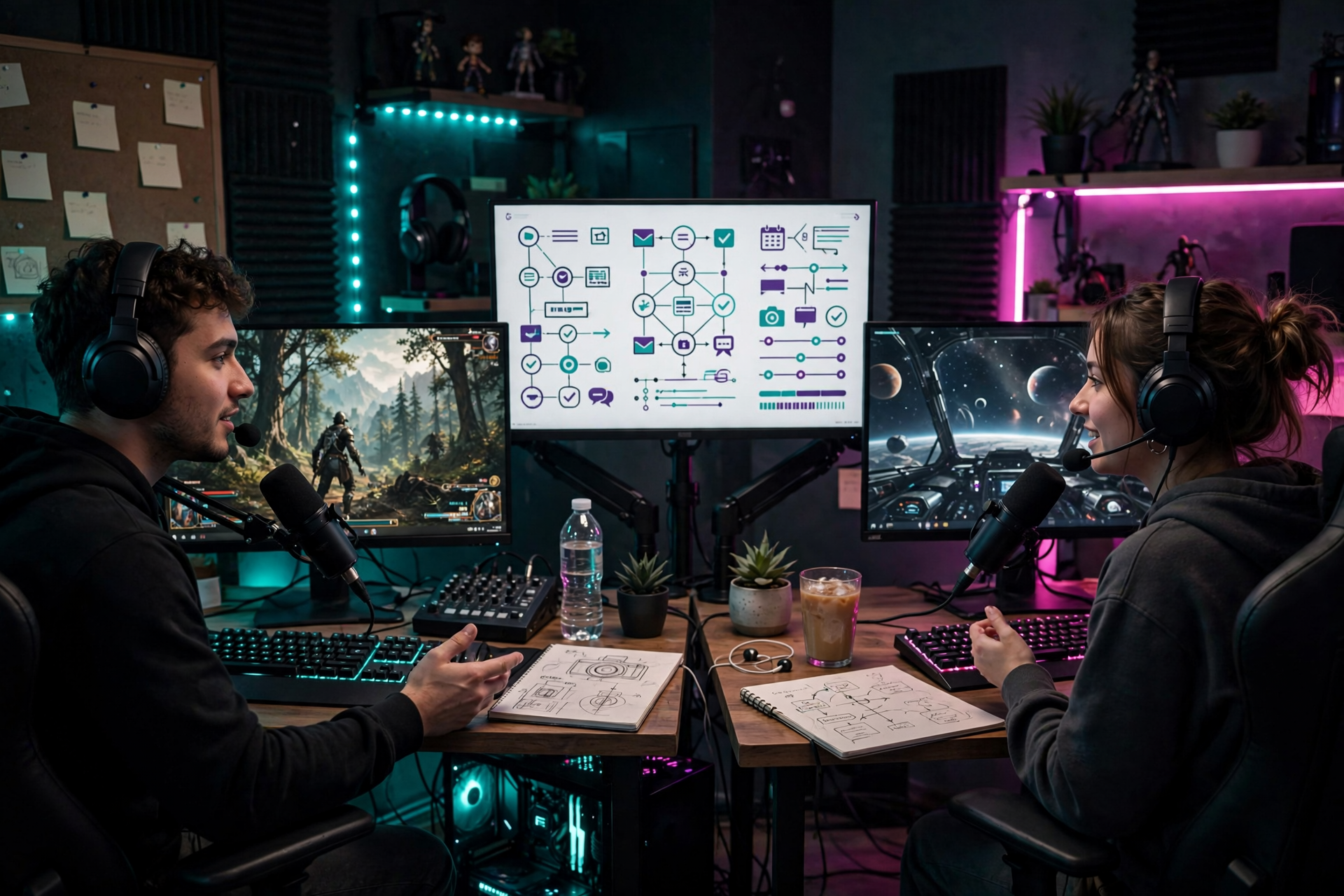
A collaboration becomes more memorable when viewers can explain what happened before, what is happening now, and where the experience goes next. Instead of treating a collab as two streamers appearing together or a raid as a last-minute handoff, build both around a simple shared story arc. Each creator contributes a distinct chapter, the audience understands the connection, and the raid becomes a natural continuation rather than a change of channel.
Choose a story that needs more than one streamer
Start with a premise that benefits from different perspectives, skills, or locations. Examples include testing the same challenge with different rules, investigating a game mystery from separate angles, completing stages of a creative project, or comparing two strategies before making a final decision. The idea should be understandable in one sentence and should give both creators something meaningful to do.
Avoid building the event around a vague promise such as “hanging out with another streamer.” That may describe the format, but it does not give viewers a reason to arrive on time or follow the story to the next channel. Write the premise as a sequence: Creator A establishes the problem, Creator B develops the solution, and the raid delivers the result, reveal, or next challenge.
Give each creator a chapter instead of identical airtime
A strong collab does not require both streamers to perform the same task for the same length of time. Assign each participant a chapter with a clear objective, a beginning, and a handoff condition. One creator might gather evidence, another might test the leading theory, and a third might host the final decision. Distinct responsibilities reduce awkward overlap and make the broadcast easier to follow.
Agree on what belongs to each channel before going live. Decide who introduces the premise, who explains the rules, who tracks progress, and who owns the final recap. This prevents both creators from repeating the same explanation while also making sure important context is not trapped in one person’s stream.
Build a run-of-show that viewers can feel
Create a short run-of-show with timestamps or trigger points rather than scripting every sentence. Include the opening premise, the first activity, the progress check, the decision point, the raid window, and the final payoff. Trigger points are more useful than rigid timing because gameplay, conversation, and technical issues rarely follow an exact schedule.
Give the audience visible progress markers during the broadcast. A simple counter, checklist, map, round number, or “what we know so far” recap helps viewers understand how the current segment contributes to the larger story. These markers also make it easier for someone who joins halfway through to catch up without forcing the creators into a long restart.
Design the raid as a scene change
The raid should answer a question created by the previous chapter. Before launching it, the sending creator can summarize the current state, name the next objective, and tell viewers exactly what they are about to see. The receiving creator should be ready with a matching opening cue, such as continuing the investigation, revealing the next rule, or showing the result of the earlier decision.
Coordinate the practical handoff in a private channel before the stream. Confirm the destination, approximate raid time, pronunciation of names, moderation contacts, and what happens if the segment runs late. On Twitch, use the normal raid flow and confirm the target before launching; never rely on a copied command or an old channel name from a previous event.
Protect both communities during the crossover
Set expectations for chat before the event begins. Tell viewers whether they should discuss clues, vote on decisions, avoid spoilers, or keep messages focused on the current chapter. Both channels should also agree on moderation boundaries, including how to handle backseating, repeated self-promotion, sensitive jokes, and viewers who treat the raid as permission to disrupt the receiving chat.
Keep the welcome specific rather than turning it into a prolonged roll call. The receiving creator can acknowledge the raid, thank the sending channel, restate the shared premise in one sentence, and immediately start the next action. This gives existing viewers something to watch while newcomers receive enough context to understand why the channels are connected.
Turn one event into a connected series
After the broadcast, review more than the peak viewer count. Note where viewers arrived, how long the transition lasted, whether the next chapter began on time, which prompts produced useful participation, and whether the final payoff was understandable to people who missed the earlier stream. A short debrief with the other creator can reveal friction that was invisible while you were live.
End with a concrete continuation when the story genuinely supports one. That might be a rematch, a community vote that determines the next rules, a joint highlight review, or a new chapter scheduled on a different day. Do not manufacture a sequel simply to keep the partnership visible; the strongest recurring collaborations are built from unfinished questions, not forced announcements.
Ready to run viewers, chatters, or followers from one dashboard?
View pricing